


NEW LEADERSHIP
‚Triple helix‘ shortens time to market
Niels Deen, the newly appointed scientific director for the Eindhoven Institute for Renewable Energy Systems (EIRES) of the Eindhoven University of Technology, may have lofty goals but he also has very down-to-earth plans to achieve them. Deen said he wants to help realize the energy transition in the Netherlands and Europe through an “architect model” and to help protect emerging energy systems from threats such as cyberattacks.
“We take the role of an architect,” he said of the institute based in Eindhoven, the Netherlands. “We try to bring people together to help build this ecosystem that you need, including a triple helix of researchers, companies, and government.” Having the three key stakeholders work in parallel could reduce the time it takes to bring new technologies to market from 20 years to only a few, he said.
Deen and Mark Cox, a senior program manager at EIRES, said that phase-change materials (PCM) could help the institute fulfill its mission, which is to enable a CO2-neutral energy system by developing solutions that deliver the energy transition to people’s homes in a manufacturable, scalable, and affordable way.
Research is still the primary strand of the triple helix. “We have what we call an energy garden, where we can have multiple pilots, which then all are part of a large energy system,” Deen said. “There is definitely room for a PCM pilot.”
“If we talk about energy transition, it is actually three things: it’s the energy system that we need to make green, it’s storage of heat, and it’s transport,” Cox said. PCMs could play a role in each of those areas, he said, especially since PCMs are developing from simple melting materials to complex 3D nanostructures.
Historically, one of the focus areas of EIRES has been on the energy transition in the built environment with smart buildings, heat storage, heat networks, and/or electricity grids in an initiative called BEHeaT. Now the university sees opportunity in other areas such as industrial heat.
The industrial sector relies heavily on natural gas for heating but geopolitical, economic, and environmental factors are driving the move to decarbonize industrial heat, Deen said, yet a surge in electrification could overwhelm the grid. PCM could be used to ease such congestion, he added.
One area of real growth opportunity for PCM is in high-temperature industrial storage. “Think about 700 to 1000°C. You get all kinds of new challenges. Your materials will be different. How stable are they? How many cycles can you do? How to recycle them? Those are also questions we’re looking into,” Cox said. “What I hear from the researchers is that the combination of high temperature heat pumps with high temperature energy storage PCM could be a golden solution for industry, which has great amounts of energy that need to be stored safely, securely, and affordably.”
Developing technology and creating a pipeline to market is critical, but so too is ensuring the safety of those tools from large-scale attacks, Deen said. The EU Agency for Cybersecurity proposed in January 2026 a Cybersecurity Act to increase cooperation to help fend off large-scale cyberattacks.
Deen said that developers of PCM energy storage systems are typically engineers and chemists who consider safety factors such as material leakage, flammability, and long-term thermal degradation. EIRES also considers cybersecurity and compliance with policy initiatives in development of its own projects and urges PCM manufacturers to do the same. “You control the system and you have to protect the system from cyberattacks,” he said.
RAL UPDATE
WHZ joins RAL as associate member
RAL Quality Association PCM welcomed the University of Applied Sciences Zwickau (WHZ) as an associate member.
WHZ joined RAL to further cultivate key relationships with PCM industry experts, said Mario Reichel, a professor of building climate technology/integrated design at the university in Zwickau, Germany. “We look forward to a scientific and technical exchange of experience, with the aim of establishing PCM storage technology more widely in the market,” he said.
Stefan Thomann, the association’s managing director, agreed, saying that the partnership is a natural one. “Our members welcome WHZ’s strong record of research and industry-supported projects that we believe will enhance RAL’s reach and expertise. Our association promotes innovation and cooperation, as well as quality standards, to advance the development and widespread adoption of PCM technology.”
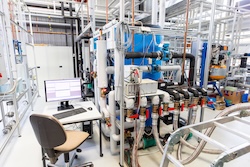 WHZ’s Building, Energy, and HVAC Technology Group is highly active in a wide range of applied research projects. Reichel gave three examples of projects with key partners.
In cooperation with two industry partners, WHZ is helping to develop a modular scalable latent heat storage system as part of the 8th Energy Research Program from the Federal Ministry for Economic Affairs and Energy. WHZ is responsible for the design of the overall system and the thermo-fluid dynamic modeling of the flow and heat transfer processes within the storage unit. The project is funded by Projektträger Jülich (PTJ), which administrates research and development funding programs on behalf of German national ministries.
Another project is in partnership with Zentrales Innovationsprogramm Mittelstand (ZIM), a central innovation program for small- and medium-sized enterprises. WHZ is helping to develop a modular, mobile, low-temperature molded block storage unit made of recycled material. WHZ is tasked with developing the overall concept and modeling the fluid-dynamic and thermodynamic processes for the modular molded block storage system and the metrological analysis of all components.
The third project Reichel named is “Energy Concepts for Fortresses, Castles and Manor Houses,” which is funded by the European Regional Development Fund (ERDF). The project includes the development of holistic energy concepts that integrate renewable energy sources while aligning with heritage conservation requirements.
Reichel said membership in RAL helps expand the university’s reach. He quoted Helen Keller, “Alone we can do so little; together we can do so much.”
CASE STUDY
Solar-powered ice storage solution aids the Red Cross
What was the problem?
An Australian Red Cross Blood Service facility in Brisbane, Australia, needed a reliable, year-round cooling solution to support its 24/7 operation. A key priority was to make effective use of solar power.
How did PCM technology solve it?
Trane Technologies (Swords, Ireland) created a solution that 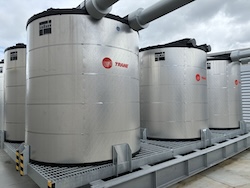 combines solar power, ice thermal storage, and advanced HVAC technology to replace the outdated infrastructure and support the facility’s operational and sustainability goals. Trane supplied the chillers, ice-making controls, and ice tanks. The tanks freeze using solar energy during the day and the ice melts to maintain conditions in the blood bank when the sun is no longer shining.
Were there any unique challenges and how did you overcome them?
Trane claims that powering an ice tank solution with solar energy to make ice is a global first. The installation improved energy efficiency, reduced power use, and provided dependable cooling.
IN BRIEF
• The Fraunhofer Institute for Systems and Innovation Research ISI is asking experts in thermal storage and district heating to participate in a short survey to understand the barriers and policy measures affecting the deployment of large-scale sensible thermal energy storage in district heating systems across different countries. The institute plans to use the survey results to help shape effective policies and accelerate the clean energy transition.
 • Ember LifeSciences, Inc., announced its alliance with Alfresa Corp., the largest domestic pharmaceutical wholesaler in Japan, giving Alfresa exclusive sales rights to Ember’s cold-chain technology in Japan’s healthcare sector in exchange for securing Alfresa as a Series A preferred stock investor in Ember. Ember LifeSciences also announced the appointment of James Braithwaite as chief product officer. Most recently, Braithwaite served as chief innovation officer at SharkNinja, where he helped expand the product portfolio into 12 new categories, contributing to growth from approximately $250 million to more than $6 billion in annual revenue.
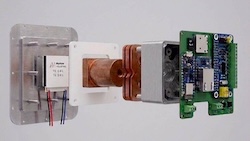 • Rubitherm Technologies GmbH’s (Berlin, Germany) 𝐑𝐓28𝐇𝐂 phase-change material is being used in the German Aerospace Center’s (DLR) „Mapheus-17“ campaign. The project is testing sensor nodes powered by thermoelectric generators (TEGs), which convert the heat of the rocket’s skin into electricity. 𝐑𝐓28𝐇𝐂 is used to extend the time that a temperature difference suitable for power generation is maintained.
• The HYBRIDplus consortium announced the completion of its pilot plant at the University of Seville (Spain). The plant will serve as an experimental platform for the validation of electrified Thermal Energy Storage (e-TES) solutions, with a particular focus on advanced cascade Phase Change Material (PCM) thermal energy storage systems.
 • Megababe’s most successful launch is COLDIES, a line of reusable neck collars and bra inserts that use phase-change material (PCM) for heat relief that accounted for nearly 40% of sales for June in only six days. “We made them for summer street heat, but customers are using them year-round for things I hadn’t even initially pictured—like hot flashes, SSRI-induced overheating and hormonal night sweats,” said founder Katie Sturino.
• Rubitherm Technologies GmbH (Berlin, Germany) has named Thermalcon (Tilburg) its distribution partner in the Netherlands.
• Defense technology company Lyntris, Inc., (Falls Church, Virginia) announced it has added phase change material (PCM) thermal management capability at its Jessup, Maryland, facility. The company invested to position itself as a vertically integrated source for passive thermal management in next-generation military systems.
• Sunamp (Macmerry, Scotland) has been granted Canadian patent number 3,107,495 for its phase-change material (PCM) heat battery technology.
• Nanolope (Berlin, Germany) raised about $925,000 in a pre-seed funding round to scale up production of thermal energy storage systems designed for existing buildings, implement pilot projects, and expand its team.
• Kyoto Group (Oslo, Norway) has named Hans Jörg Fell as its chief technology officer (CTO) to make Heatcube a scalable, cost-competitive product for industry worldwide.
• The Long Duration Energy Storage Council is inviting a select group of customers, investors, policymakers, and ecosystem partners to join its flagship LDES Council Annual Member Meeting in Madrid, Spain, on Oct. 6. Learn more about the #LDESCouncil26 and request an invitation.
JOBS
• Peli BioThermal is hiring a Manufacturing Engineer III in Indianapolis, Indiana. The candidate should have 7+ years of manufacturing engineering experience within a regulated manufacturing environment and ideally has experience supporting pharmaceutical, medical device, biotechnology, cold chain, or other regulated manufacturing environments and knowledge of passive temperature-controlled packaging technologies.
• Thermophoton is in need of a Ph.D. candidate to work on „Modeling and Experimental Demonstration of Thermosyphon Systems for Ultra-High-Temperature Thermal Energy Storage“ at the Instituto de Energía Solar – Universidad Politécnica de Madrid. Candidates should send a motivation letter, CV, and academic transcripts to contact@thermophoton.com by Sept. 15.
• CIC energiGUNE (Vitoria-Gasteiz, Spain) is hiring for a range of roles.
• Emerald Horizon AG (Graz, Austria) is hiring for a range of roles, including a mechanical engineer — high temperature.
• Advanced Cooling Technologies, Inc., (Lancaster, Pennsylvania) is hiring for a range of roles at various locations.
PATENTS
System and method for storing and recovering hydrogen
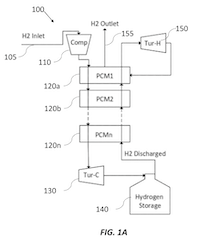 U.S. patent application 20260209037 (applicant Ariel Scientific Innovations, Ltd., Ariel, Illinois):
„A system for storing and recovering hydrogen is disclosed. The system may include: a hydrogen inlet; a first phase change material (PCM) unit configured to regenerate the hydrogen to a first temperature; a compressor fluidically connected at one of: between the hydrogen inlet and the first PCM unit, for providing a first pressure level to the hydrogen; or to the at least the first PCM unit via a cooler for providing the first pressure level to cooled hydrogen, and a hydrogen sorbent bed (HSB) storage configured to receive a
depressurized cooled hydrogen from one of, the first PCM unit or the compressor, wherein the hydrogen pressure level at the entrance to the HSB storage is at most 80 bar and the temperature at the entrance to the HSB storage is between 20 to 180 K.“
Phase change material production kit and use thereof
U.S. patent application 20260242652 (applicant Sunamp, Ltd., Edinburgh East Lothian, Scotland):
„There is herein described a kit for producing PCMs comprising one or more additives. There is also described a method of manufacturing a PCM, the method comprising using a kit as described herein and a latent heat storage material or precursor thereof. In particular, there is described a kit for producing PCMs comprising one or more additives. There is also 5 described a kit and method of use thereof for producing PCMs which comprises no loose powders, granules, and/or flakes.“
Localized thermal protection of medical devices
U.S. patent application 20260224843 (applicant Boston Scientific Scimed, Inc., Maple Grove, Minnesota):
„Devices for localized thermal protection of a medical device are disclosed. An example localized thermal protection device for use with a medical device may include a cylindrical body including a first layer and a second layer. The first layer may include a first substrate and a first phase change material disposed along the first substrate. The second layer may include a second substrate and a second phase change material disposed within the second substrate. The cylindrical body may be configured to be disposed about a discrete temperature-sensitive region of a medical device.“
RESEARCH ROUNDUP
From Journal of Energy Storage:
• Fabrication and properties of flexible phase change functional fibers and phase change microcapsule-based temperature-controlled materials used in smart temperature-regulating fabrics
• Synergistic effect of graphene nanoplatelets and biochar on salt hydrate phase change material for high-performance thermal energy storage and electronic cooling
• Dual-network polyethylene glycol-based phase change materials for thermal energy storage with enhanced heat transfer and shape stability
• Performance study of flexible, flame-retardant, and sustainable energy storage composite phase change materials based on phosphorylated cellulose skeleton
From International Journal of Heat and Mass Transfer:
• Pressure- and temperature-dependent dynamic model of a barocaloric phase change material thermal energy storage device
• Multi-objective optimization of cascaded PCM packed-bed thermal energy storage systems considering charging–discharging thermocline trade-offs
• Design of a phase change thermal energy storage heat exchanger based on topology optimization
From Applied Thermal Engineering:
• Thermal performance evaluation and predictive modelling of cylindrical thermal energy storage tanks using nanoparticle-enhanced phase change materials
• Thermal performance enhancement of sodium acetate trihydrate phase change material by protic ionic liquids for thermal energy storage
• A nature-inspired lithium-ion battery thermal management system with synergistic optimization of honeycomb-type battery compartment and snowflake-shaped fins
• Effect of dendritic PCM forest configuration on near-isothermal compression-expansion in liquid piston system
From Journal of Thermal Analysis and Calorimetry:
From Composites Part B: Engineering:
From Energy Conversion and Management:
From Renewable and Sustainable Energy Reviews:
From International Journal of Thermal Sciences:
• A network-stabilized flexible composite phase change fabric for battery thermal management
From Chemical Engineering Journal:
From Energy:
• Preparation and performance study of modular integrated hydrated salt phase change gel radiant floor heating for high-energy-efficiency buildings
• Construction of galactitol–sodium pyrophosphate composite phase change materials and their performance in cascade thermal energy storage systems
From International Communications in Heat and Mass Transfer:
NETWORKING
Connect with PCM experts and industry leaders on LinkedIn
 More than 1,800 people have joined a LinkedIn group devoted to the discussion of phase change material and thermal energy storage. You are invited to join the Phase Change Matters group and connect with PCM and TES experts from around the world.
This month we welcome Jerry Augustine, field maintenance engineer at Huawei, Lagos, Nigeria; Christian Overbey, of Christian Overbey Architect, LLC, Denver, Colorado; Ángel Serrano Casero, research line manager: thermal energy storage technologies at CIC energiGUNE, Vitoria-Gasteiz, Spain; Sophie B., product development manager at Temprecision International, Washington, England; Jessica Lund, marketing executive at Temprecision International, Washington, England; Emily Dinino, founder and CEO at ThermoShade, Los Angeles, California; uma lanka, assistant vice president at Crompton Greaves Consumer Electricals, Ltd., (CGCEL), Mumbai, India; Esther Kieseritzky, general manager at Rubitherm Technologies GmbH, Berlin, Germany; and Anand Prakash, scientific program manager at Ecozen, Maharashtra, India.
NEWS TIPS
Does your company, agency or university have a job opening, new research, new product or other news you’d like to share? I would love to hear from you. Please contact newsletter editor Amy Phillips at phasechangematters@gmail.com.
A WORD FROM OUR SPONSOR
 This newsletter is made possible through the generous support of the RAL Quality Association PCM and the members listed below. To learn more about the association, including membership benefits, please contact Stefan Thomann, executive director, at pcm@kellencompany.com.
Axiotherm GmbH | Croda Europe, Ltd. | Hangzhou Ruhr New Material Technology Co., Ltd. (RuhrTech) | ISU Chemical Co. Ltd. | Ningbo Passive Edge Material Co., Ltd. | PCM Technology |PLUSS Advanced Technologies, Ltd. | Rubitherm Technologies GmbH | Sasol Germany GmbH | Sunamp, Ltd. | Associate members: Lucerne University of Applied Sciences (HSLU) | University of Applied Sciences Zwickau (WHZ)